Hades: God Mode
Hades' God Mode grants escalating damage resistance with each death. Unlike Celeste's granular options, it's a single toggle that adapts automatically - proving there's more than one way to design accessibility.
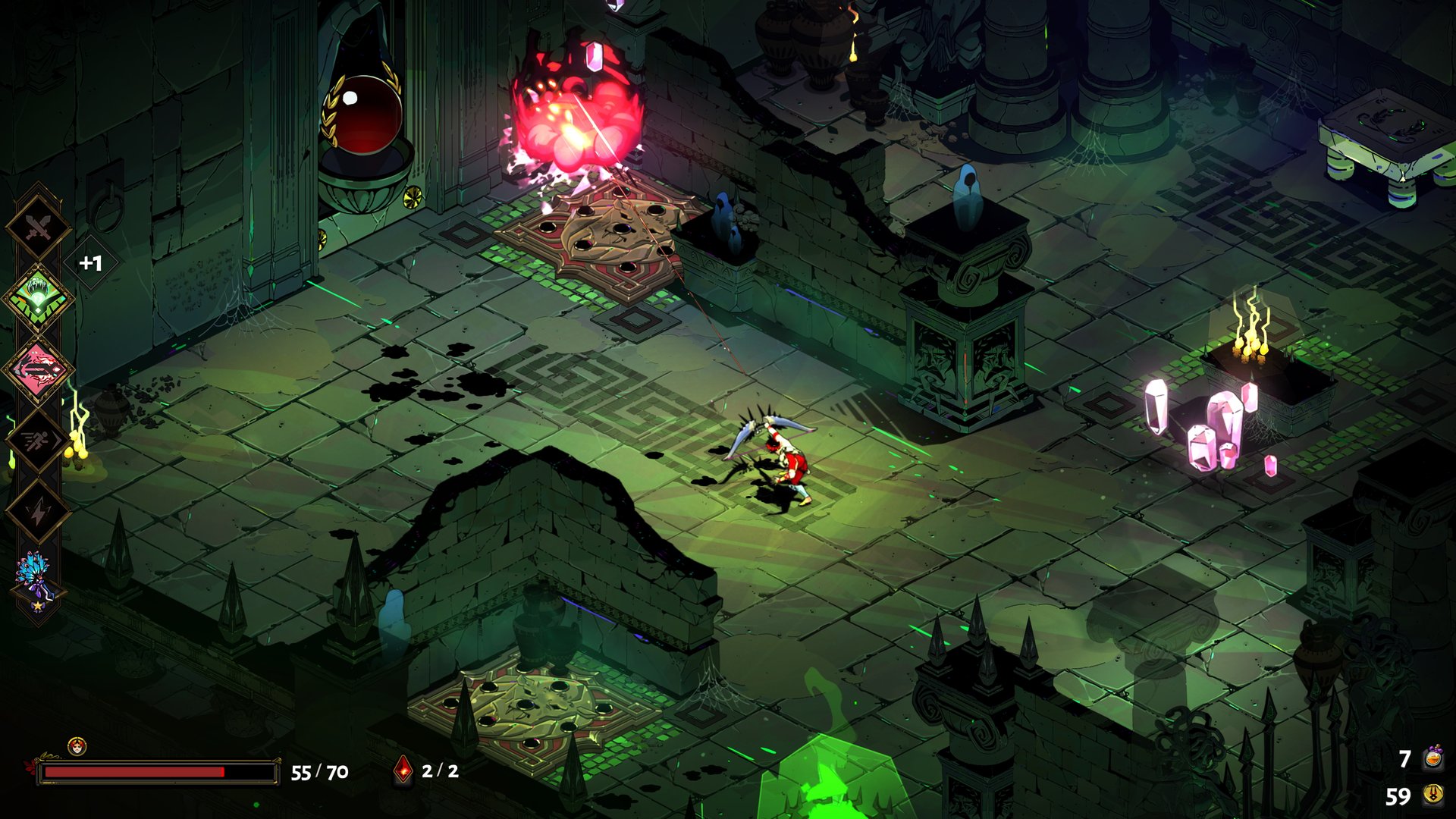
How It Works
God Mode is simple:
- Toggle it on in settings
- You start with 20% damage resistance
- Each time you die, resistance increases by 2%
- Maximum resistance caps at 80%
That's it. No sliders, no options, no configuration. Just one toggle and an automatic escalation system.
The Math
| Deaths | Resistance | Effective Health |
|---|---|---|
| 0 | 20% | 1.25x |
| 10 | 40% | 1.67x |
| 20 | 60% | 2.5x |
| 30 | 80% (max) | 5x |
The resistance never goes back down. Once earned, it's permanent (unless you toggle God Mode off entirely).
How It's Presented
When enabling God Mode, the videogame shows:
"God Mode gives you a permanent +20% damage resistance, growing by +2% each time you die (up to 80%). You can turn God Mode off at any time. It doesn't prevent you from unlocking anything or doing anything in the game."
Key elements:
- Clear mechanical explanation
- Emphasizes it's reversible
- Explicitly states no content is locked
- Framed as a feature, not a concession
What God Mode Changes
God Mode affects:
- Damage taken (reduced)
That's all. Everything else remains identical:
- Enemy patterns unchanged
- Damage you deal unchanged
- Boss mechanics unchanged
- Story, unlocks, achievements unchanged
- Visual indicator (subtle glow) appears on health bar
The 4 A's Perspective
God Mode primarily modifies Action:
- Action: Combat becomes more forgiving. Mistakes cost less.
- Arc: Largely unchanged - runs take similar time. You might attempt harder Heat levels sooner.
- Art: Minimal visual change (health bar glow).
- Atmosphere: Less punishing, potentially less tense. But still demanding.
The Gesture of combat remains intact. You're still dodging, dashing, and timing attacks. You just survive longer when you mess up.
Try This
Compare two runs
Play a run without God Mode, then enable it for the next run. What feels different? What stays the same?
Notice the psychology
With God Mode, how does your relationship with death change? Do you play more aggressively? Take more risks?
Why Use This Case Study
Hades' God Mode offers a different accessibility philosophy than Celeste. Comparing them illuminates tradeoffs:
| Aspect | Celeste Assist Mode | Hades God Mode |
|---|---|---|
| Configuration | Granular (5+ options) | Binary (on/off) |
| Adaptation | Manual (player chooses) | Automatic (system responds) |
| Direction | Static | Escalating |
| Cognitive load | Higher (what to enable?) | Lower (just toggle) |
Neither is "better." They solve different problems for different videogames.
Teaching Sequence
- Have students play Hades normally (experience the roguelike loop)
- Enable God Mode; play multiple runs
- Discuss: How does the automatic escalation feel compared to manual options?
- Compare with Celeste's Assist Mode
- Design exercise: Which approach would you use for your videogame, and why?
Discussion Prompts
- Why might Hades have chosen automatic escalation over manual configuration?
- Does the 2% incremental increase feel different from immediately having 80% resistance?
- What does the cap at 80% communicate about design intent?
- Would God Mode work for Celeste? Would Assist Mode work for Hades?
The Roguelike Factor
Hades' God Mode works because dying is already part of the videogame. In a roguelike:
- Death is expected and frequent
- Progress persists across deaths (meta-progression)
- The story frames death as canonical (Zagreus returns from the Styx)
God Mode leverages what's already there. Death counts up resistance automatically because death is already being counted. The system is elegant because it builds on existing mechanics.
Common Misconceptions
"God Mode makes the videogame too easy"
At 80% resistance, you still take damage. Bosses still have complex patterns. The videogame is easier, not trivial. And players can turn it off anytime.
"The escalation is just training wheels"
Some players keep God Mode on permanently. That's valid. Others use it temporarily. The design accommodates both without judgment.
Dynamic Difficulty Adjustment
God Mode is a form of transparent DDA (Dynamic Difficulty Adjustment). Unlike hidden DDA systems (which secretly make videogames easier), God Mode:
- Requires explicit opt-in
- Shows its numbers clearly
- Never activates without consent
This transparency matters. Hidden DDA can feel patronizing ("the videogame thinks I need help"). God Mode says: "Here's a tool. Use it if you want."
Permissions and Thresholds
From a Permissions perspective, God Mode shifts what's required:
- Without God Mode: Perfect play required for certain challenges. High skill floor.
- With God Mode: Imperfect play becomes viable. Lower skill floor.
The videogame still requires combat engagement. It doesn't require mastery.
Why 80% Cap?
The 80% cap is deliberate. At 100% resistance, combat would become meaningless - you could ignore all mechanics. At 80%, you're still mortal:
- Boss attacks still hurt
- Attention still required
- Death still possible (just less likely)
This preserves what makes Hades feel like Hades. The cap protects the core experience while expanding access.
The Earned Escalation
God Mode's resistance is "earned" through death. This creates an interesting psychological framing:
- You're not given easy mode - you build toward it
- Each death contributes to future success
- The videogame acknowledges your struggles by responding to them
Whether this framing is helpful or just narrative sugar depends on the player. Some find it empowering. Others just want the assistance without the theater.
Roguelike Accessibility
Roguelikes present unique accessibility challenges:
- Long play sessions before checkpoints
- Loss of progress on death
- Compound difficulty from randomness
- Skill checks that gate all content
God Mode addresses the skill check problem without touching the roguelike structure. You still do full runs, still face randomness, still build meta-progress. The videogame just hurts less.
Unresolved Questions
- Should God Mode affect damage dealt, or just received? What would change?
- Is the escalation necessary, or would a fixed resistance work equally well?
- Does the 2% increment feel like "earning" assistance or just "grinding" it?
- Would other roguelikes benefit from this approach, or is it specific to Hades' design?
Related
- Celeste: Assist Mode - contrasting accessibility approach
- Accessibility as Craft - the philosophy behind this
- Permissions - how difficulty shapes permission structures
- Player Psychology - motivation and frustration