Dialogue Systems
Any system that supplies conversation or interaction in your videogame's world. The need to create systems that support communication and guidance is paramount.
What Dialogue Systems Are
A dialogue system is the interface and logic that governs conversation in a videogame. It determines how players talk to characters, how characters respond, and how conversations flow.
Dialogue systems are where narrative meets interface design. The structure of conversation shapes what kinds of stories you can tell.
Core Components
Triggering: How do conversations start?
- Automatic (enter area, story triggers)
- Player-initiated (talk button near NPC)
- Contextual (interrupt after certain actions)
Display: How is dialogue presented?
- Text boxes
- Voiced audio with subtitles
- Speech bubbles
- Full-screen conversational UI
Player Input: How does the player participate?
- Advance text (passive)
- Select from options
- Type responses (parser)
- Timed choices
- No input (cinematic)
Flow Control: How does conversation progress?
- Linear (one path)
- Branching (multiple paths)
- Hub-and-spoke (return to menu of topics)
- State-based (available options depend on flags)
Common Structures
Simple Linear: Player advances through fixed text. No choices. Use for exposition, atmospheric flavor, world-building.
Menu Selection: Player chooses from a list of topics/responses. Use for information gathering, controlled exploration.
Branching Tree: Choices lead to different dialogue paths that may reconverge or diverge. Use for roleplaying, consequence, character expression.
Hub and Spoke: Keep returning to a central menu after each topic is explored. Use for investigation, lore, optional depth.
The Option Problem
What the player sees vs. what the character says is a design choice:
| Approach | Example | Pro | Con |
|---|---|---|---|
| Full preview | "I'll help you find your daughter" | Player knows exactly what they're choosing | Long, can break flow |
| Paraphrase | "[Agree to help]" | Clean, brief | Player may disagree with delivery |
| Tone tag | "[Sympathetic]" | Expresses character without spoiling | Ambiguous |
| First words | "I'll help you..." | Natural, like real conversation | Can be misleading |
Mass Effect used a tone-based wheel that sometimes delivered lines players didn't expect. Disco Elysium shows full text. Neither is "correct" - they serve different experiences.
Conversation as Gameplay
Dialogue can be more than information delivery - it can be play.
- Ace Attorney: Present evidence during testimony, catch contradictions
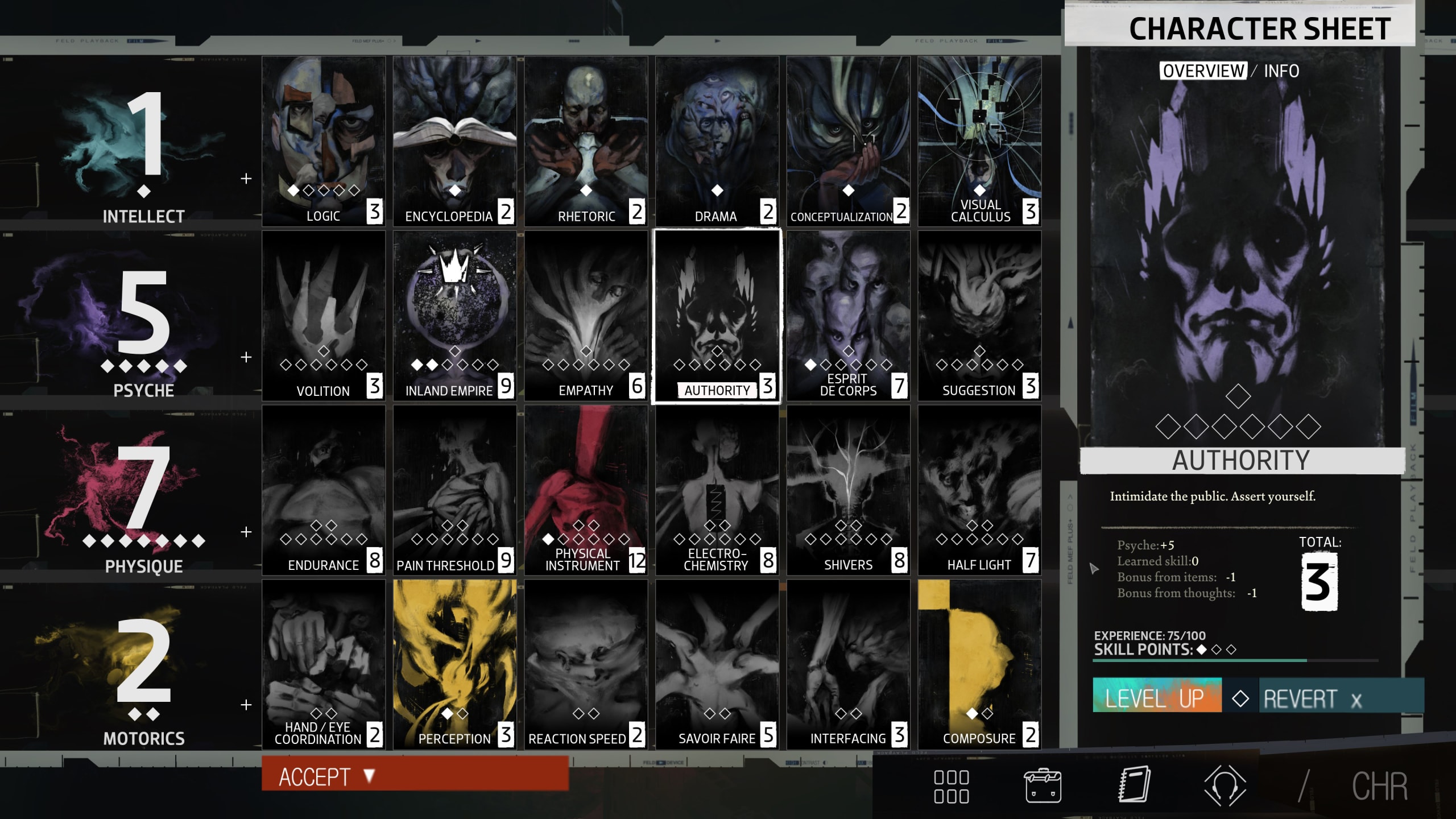
- Disco Elysium: Skill checks embedded in dialogue, your thoughts argue with each other
- Hades: Brief, contextual exchanges that deepen over dozens of runs
When dialogue is gameplay, it needs stakes (what can I win or lose?), player agency (what decisions matter?), and feedback (how do I know what worked?).
Exercise: Dialogue Autopsy
Take a dialogue sequence from a published videogame. Map:
- What's the structure? (Linear, branching, hub?)
- How is text displayed?
- What player input is required?
- How are options presented?
Why Teach This
Dialogue systems are where writing meets UI/UX. Students often think about dialogue as pure writing, ignoring that the structure of conversation constrains what stories can be told.
The right approach depends entirely on design goals and Aesthetic Heritage of the genre. A visual novel, an action RPG, and a puzzle videogame all need fundamentally different dialogue systems.
Common Misconceptions
"More options = better dialogue"
Students often want to add more choices without considering scope or whether choices matter. A few meaningful choices beat many meaningless ones.
"Voice acting is always better"
Voice acting is expensive and constrains iteration. Text-only dialogue allows for more content, faster changes, and player projection onto characters.
Assessment
Ask students to:
- Map the dialogue structure of an existing videogame
- Redesign a linear dialogue sequence as branching (and vice versa)
- Design a dialogue encounter where conversation IS the gameplay
Historical Lineage
Infocom - Parser-based interactive fiction that pioneered computer conversation. "Ask about" and "tell about" as primary verbs.
BioWare - The dialogue wheel, romance options, companion relationships. Defined modern RPG conversation expectations.
ZA/UM (Disco Elysium) - Pushed dialogue as gameplay. Your skills are characters in the conversation. Showed that text-heavy videogames can succeed commercially and critically.
Current Questions
LLMs and procedural dialogue: How will large language models change dialogue systems? Potentially infinite variation, but loss of authorial control. The tradeoff between authored precision and generative flexibility is unresolved.
Pacing: Is there a "natural" dialogue pacing? How long should text stay on screen? How fast should it scroll? These are UX questions with narrative implications.
Related
- Branching & Consequence - how dialogue choices create story paths
- Permissions - dialogue as permission system
- Aesthetic Heritage - genre determines approach
Glossary Terms
- Dialogue Tree - branching conversation structure
- Barks - short contextual voice lines
- Hub and Spoke - menu-based conversation structure