Portal: Level One
Portal's first test chamber teaches the core mechanic without a single line of tutorial text. It's a masterclass in implicit instruction - showing instead of telling, constraining instead of explaining.
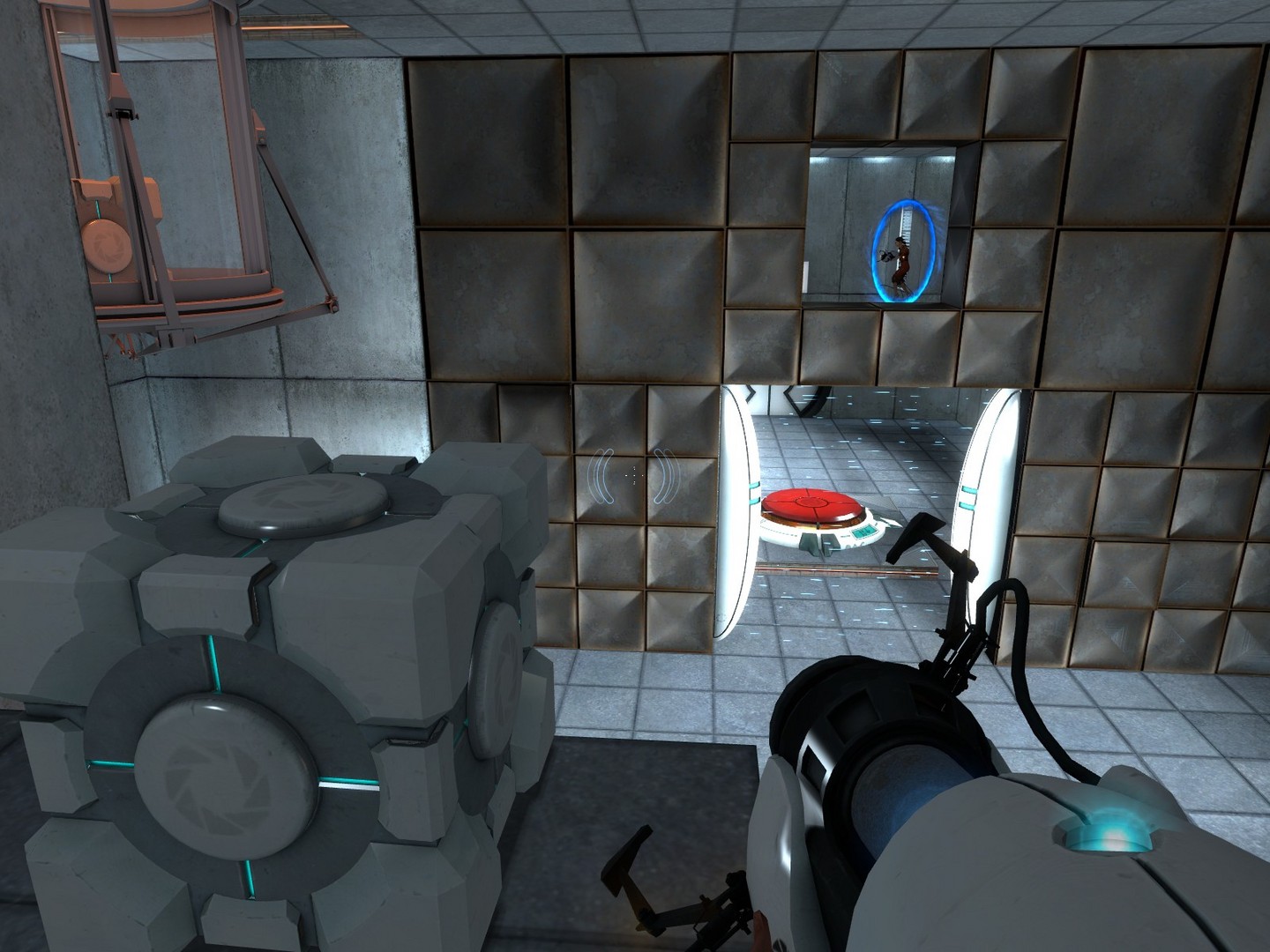
The Setup
You wake up in a glass box. There's a radio, a toilet, and a bed. Outside the glass, you see a room with a door. A timer counts down. When it hits zero, an orange portal opens on the wall outside. Through it, you can see... yourself. From behind.
What You Learn (Without Being Told)
| Lesson | How It's Taught |
|---|---|
| Portals connect two places | You see yourself through the portal - it's showing you from another angle |
| You can walk through portals | The only exit is through the portal. No other option. |
| Portals preserve orientation | Walking through doesn't disorient you. You exit the way you entered. |
| The blue portal exists too | After exiting, you see the blue portal on the chamber wall |
| Orange and blue are linked | Looking back through blue, you see where you came from |
What's NOT In Level One
Critically, the first chamber does NOT include:
- Text instructions ("Press E to interact")
- Button prompts on screen
- A portal gun (you don't get it until later)
- Multiple paths or choices
- Enemies or hazards
- Time pressure (after the initial countdown)
The level is stripped to essentials. One concept. One path. No distractions.
The 4 A's Perspective
- Action: Minimal - walk, look. The simplicity focuses attention on the portal.
- Art: Clean, clinical environment. The orange portal glows against sterile white. Visual hierarchy is unmistakable.
- Arc: Brief. Maybe 30 seconds for most players. Long enough to understand, short enough to maintain curiosity.
- Atmosphere: Curious and slightly unsettling. You're being watched. Tested. The vibe is established immediately.
Try This
Time yourself
How long does it take a first-time player to complete Level One? Watch someone who's never played. Where do they pause? What do they examine?
Reverse engineer it
List everything Level One teaches. Now list what it deliberately excludes. What gets introduced in Level Two? Level Three?
Why Use This Case Study
Portal's first chamber is the canonical example of implicit tutorial design. Valve documented their process extensively in developer commentary, making it perfect for teaching:
- The problem: How do you teach a mechanic that doesn't exist in other videogames?
- The solution: Constrain the space until only the desired action is possible
- The principle: Show, don't tell. Better yet, make the player do.
Teaching Sequence
- Have students play through first three chambers blind
- Discuss: What did you learn? When did you learn it?
- Replay with developer commentary enabled
- Map each chamber to its teaching goal
- Design exercise: Create a tutorial for a novel mechanic using only space and constraints
The Valve Method
Valve's tutorial philosophy, refined across Half-Life, Portal, and Left 4 Dead:
- Isolate the concept - Remove everything except what you're teaching
- Constrain the space - Make the correct action the only obvious action
- Let them discover - Player agency feels better than being told
- Repeat with variation - Same concept, different context, increasing complexity
Level One exemplifies all four. The glass box isolates. The single exit constrains. Walking through is discovery. Later chambers repeat with variation.
Discussion Prompts
- Why does Level One let you see yourself through the portal? What would change if you couldn't?
- What's the purpose of the countdown timer?
- Why include the radio and toilet? (Hint: it's about making the space feel real)
- How does Portal's implicit approach compare to explicit tutorial text?
Common Student Mistakes
Over-explaining: Students often want to add text "just to be safe." Push them to trust spatial design.
Adding too much: The temptation is to teach multiple things at once. Portal's discipline is one thing per chamber.
Forgetting repetition: One exposure isn't enough. Players need to apply concepts multiple times with variation.
Developer Commentary
Portal includes built-in developer commentary. Enable it for educational use - Valve's designers explain their decisions at each moment. It's a free masterclass.
Implicit vs Explicit Instruction
Tutorial design falls on a spectrum:
| Implicit | Explicit |
|---|---|
| Player discovers | Videogame explains |
| Spatial constraints | Text/voice instructions |
| Feels like playing | Feels like learning |
| Easy to miss | Hard to miss |
| Memorable through doing | Memorable through reading |
Neither is universally better. Portal uses implicit instruction because its mechanic is spatial - the best way to understand portals is to walk through one.
Affordance and Constraint
Level One works through constraint more than affordance:
- Affordance: The portal looks like something you can walk through
- Constraint: The glass box prevents any other action
The affordance invites. The constraint requires. Together, they teach.
The Permissions Angle
From a Permissions perspective:
- Allowed: Walk, look, exist in the space
- Required: Walk through the portal to progress
- Forbidden: Everything else (glass walls, no other exits)
By narrowing permissions, Level One makes the desired action inevitable. This is permission design as tutorial.
Aesthetic Heritage: The Test Chamber
The test chamber format draws from scientific experimentation aesthetics - clean, controlled, observable. This serves multiple purposes:
- Justifies the artificiality of isolated teaching spaces
- Establishes the Aperture Science fiction
- Creates expectation for increasing complexity (you're being tested)
- Makes the behind-the-scenes sections more impactful by contrast
The Aesthetic Heritage of the laboratory isn't just visual - it's structural.
Unresolved Questions
- How much does implicit instruction rely on player patience? What about players who want to "get to the good part"?
- Can implicit instruction work for abstract or non-spatial mechanics?
- Is there a genre bias in implicit design? (Puzzle videogames expect it; action videogames often don't)
- What's lost when players skip tutorial content? Is that their right?
Related
- Level Design - spatial teaching principles
- Permissions - how constraints create meaning
- Player Psychology - learning and discovery