Emergent Behavior
Emergence is when simple rules combine to produce complex, unexpected behaviors. It's when the videogame surprises its own designer. Emergent behavior is why Dwarf Fortress creates tragedies no author wrote, why Breath of the Wild enables solutions no designer anticipated, and why multiplayer videogames generate stories that single-player videogames can't.
What Is Emergence?
Emergence = macro-level patterns arising from micro-level rules.
The rules of chess are simple: how pieces move, capture, check. The strategies that emerge - openings, defenses, endgames - are not written in the rules. They emerge from players interacting with rules over time.
Emergence means the videogame has more possibility than you explicitly designed.
Why Designers Love Emergence
Content Multiplication: Designers create rules. Players create content by combining those rules.
Breath of the Wild: Physics + fire + wind + enemies = infinite videos of creative kills.
Replayability: Emergent systems aren't solved. Each playthrough produces different patterns.
Player Authorship: Players feel like co-creators. The story that emerges is their story.
Surprise: Even the designer discovers new behaviors. The videogame is bigger than its creator.
Why Emergence Is Hard
Unpredictability: You can't fully predict what will emerge. Playtesting reveals, but can't cover everything.
Exploits: Players find emergent behaviors that break the videogame. "Emergent" can mean "broken."
Balance Difficulty: Emergence + balance = nightmare. Systems interact in untestable combinations.
Narrative Dilution: Authored meaning requires control. Emergence cedes control. Hard to have both.
Designing for Emergence
You can't design emergent behaviors directly - you design the conditions for emergence.
Combinable Elements: Systems that interact with each other. Fire spreads. Water conducts electricity. Enemies have physics.
Consistent Rules: Rules that always apply. If fire burns wood, it burns ALL wood - barrels, bridges, weapons.
Player-Readable Interactions: Players can predict (roughly) how combinations will work. Transparency enables experimentation.
Forgiving Failure: If experimenting is punished, players don't experiment. Emergence needs safety to explore.
Sandbox Spaces: Areas where players can test combinations without stakes.
Emergence vs. Randomness
Emergence isn't randomness.
| Emergence | Randomness |
|---|---|
| Deterministic rules → unpredictable outcomes | Non-deterministic events |
| Player understands why it happened | Player doesn't control |
| Replayable (same inputs → same outputs) | Variable (same inputs → different outputs) |
| Surprising but explicable | Surprising and arbitrary |
Emergence feels like discovery. Randomness feels like luck (or bad luck).
Emergent Narrative
Emergent narrative = stories that arise from systems rather than scripts.
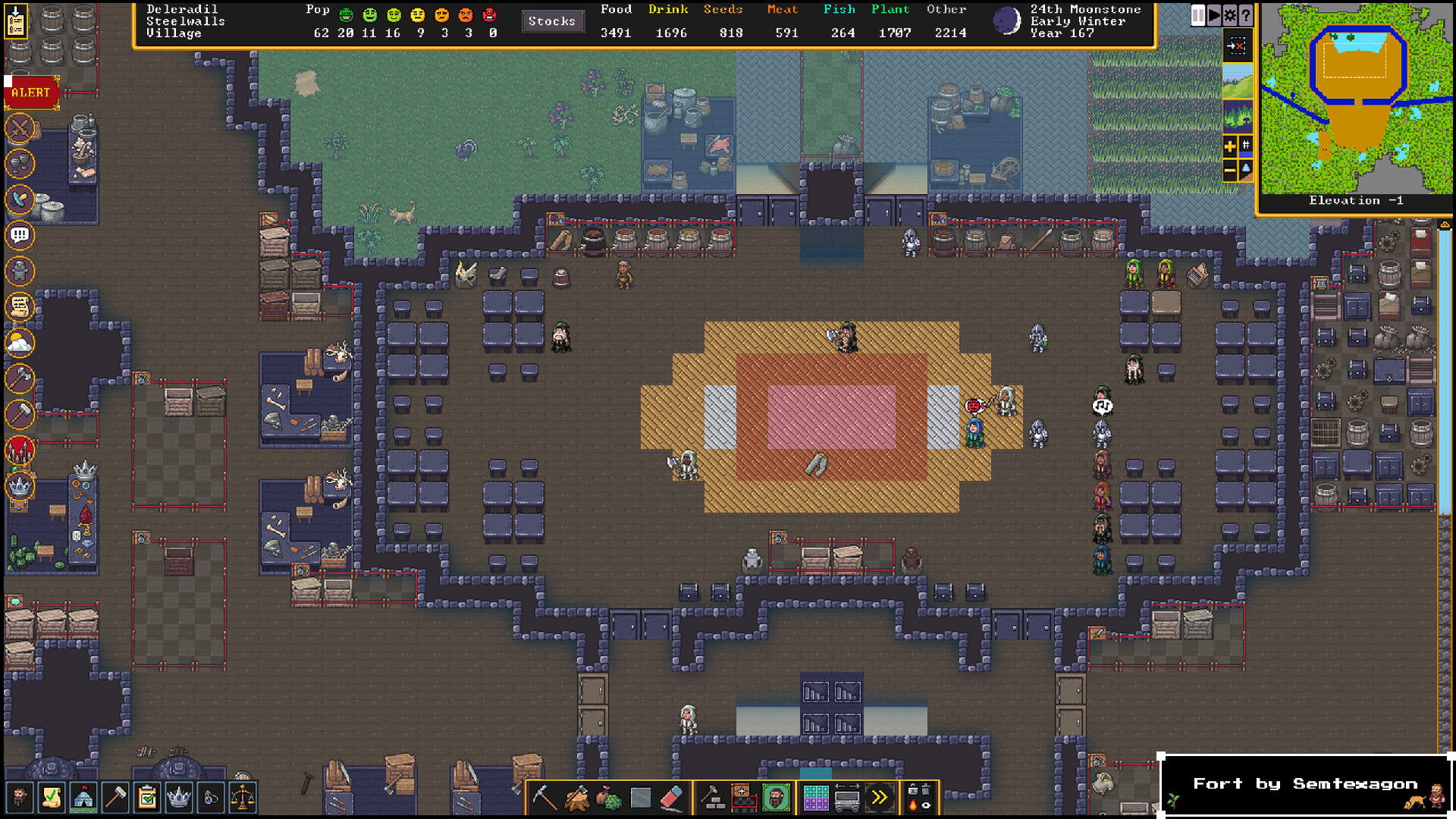
Dwarf Fortress generates stories: a dwarf loses their spouse, falls into despair, drinks too much, stumbles into the forge, starts a fire, destroys the fort.
No author wrote that. The systems produced it.
What Enables Emergent Narrative:
- Agents with goals and states (characters who want things)
- Systems that create consequences (actions affect world state)
- Player interpretation (humans find stories in patterns)
Limits of Emergent Narrative:
- Rarely has dramatic structure (no rising action, climax)
- Can feel arbitrary or meaningless
- Lacks authored emotional arc
- Requires player investment to "see" the story
Emergent narrative supplements, but rarely replaces, authored narrative.
Case Studies
Dwarf Fortress: Maximum emergence. Simple AI rules for dwarves, complex interactions with environment, no authored story. Players project narrative onto simulated events.
Noita: Physics-based emergence. Every pixel is simulated. Fire spreads, liquids flow, explosions chain. The videogame is constantly surprising itself. Death comes from interactions you couldn't predict but understand in retrospect.
Breath of the Wild: Constrained emergence. Physics systems interact predictably. Players discover combinations. Authored story exists alongside emergent play.
Hitman: Curated emergence. Systems enable many solutions, but levels are designed to suggest specific emergent moments.
Chess: Pure emergence. No narrative, just strategy arising from rules.
Exercise: Emergence Observation
Play a systemic videogame (Breath of the Wild, Noita, Divinity: Original Sin). Document three emergent moments:
- What happened?
- What rules combined to produce it?
- Could the designer have predicted this?
Why Teach This
Emergence is where systems design becomes exciting - and where it gets hard to predict. Students need to understand both the promise (content multiplication, player authorship) and the challenge (exploits, balance nightmares).
Common Misconceptions
"Emergence = good design"
Students sometimes treat emergence as inherently positive. But emergence can produce broken games, meaningless noise, or exploitative behaviors. Emergence is a tool, not a virtue.
"Add more systems = more emergence"
Emergence requires systems that interact. Parallel systems that don't touch each other don't create emergence - they create complexity without depth.
Assessment
- Can students distinguish emergence from randomness?
- Can students identify the conditions that enable emergence in a videogame?
- Can students predict potential emergent behaviors (and potential exploits) from a rule set?
Teaching Exercise: Emergent System Design
Design a simple system (5-7 rules) that you believe will produce emergent behavior. Then test with classmates. Did expected emergence appear? What surprised you?
Key insight: You design rules, not emergence. Emergence is a gift from the rules to the players.
Key References
Steven Johnson - Emergence. Accessible introduction to emergence as a phenomenon.
Jesper Juul - Half-Real. The relationship between rules and fiction; emergence as a game-specific concept.
Warren Spector / Deus Ex - Immersive sim design philosophy: authored spaces, emergent solutions.
The Humility of Emergence
Emergence requires letting go. You can't control everything. Good design creates conditions and then steps back. This is philosophically challenging for designers who want to author specific experiences.
The "Emergence Is Always Good" Myth
Emergence can produce broken videogames, meaningless noise, or exploitative behaviors. Emergence is a tool, not a virtue. The question isn't "does this videogame have emergence?" but "does this emergence serve the experience?"
Unresolved Questions
- How much emergence is enough? Too little = linear; too much = chaos.
- Can emergence and authored meaning coexist? Or are they in tension?
- Whose story is an emergent narrative? Designer's? Player's? System's?
Related
- Player Psychology - feedback loops drive emergence
- Balance Philosophy - emergence complicates balance
- Permissions - emergence emerges from what's allowed
Glossary Terms
- Emergence - complex from simple
- Immersive Sim - genre built around emergence
- Systemic Design - designing for interaction